Introduction
A Standard Deviation Calculator is a statistical tool that is quite useful in calculating the standard deviation of a set of values. It helps students, teachers, researchers, analysts, and business professionals understand the spread of data without having to do tedious manual calculations. Education, science, healthcare, finance, sports, and business are all areas that gather data on a daily basis. Looking only at the average does not always provide the complete picture.
The average of two sets of data may be the same, although the spread of the data is quite different. Standard deviation is a measure of that variation and is indicative of whether the values are concentrated or spread out. To calculate each step individually would be a tedious process; however, a standard deviation calculator works with the data and instantly produces accurate results. It will save you time, minimize mistakes, and make statistical analysis much easier.
A standard deviation calculator is a useful tool to interpret data, regardless of whether you are working with mathematics, survey data, or business data.
What is a Standard Deviation Calculator
A Standard Deviation Calculator is a tool that calculates the standard deviation of a set of data. A Standard Deviation Calculator is an online statistical calculator that is used to calculate the standard deviation of a set of numbers. Users simply enter a list of values into the calculator. It then derives the average, measures deviation from the average, and uses a statistical formula to calculate the standard deviation.
Other statistics are available on many calculators, including the sum of the values, the number of values, the minimum value, and the maximum value. This provides insight into the data as a whole. All calculations are automatic, allowing it to be used by beginners and experts.
Standard Deviation Calculator working
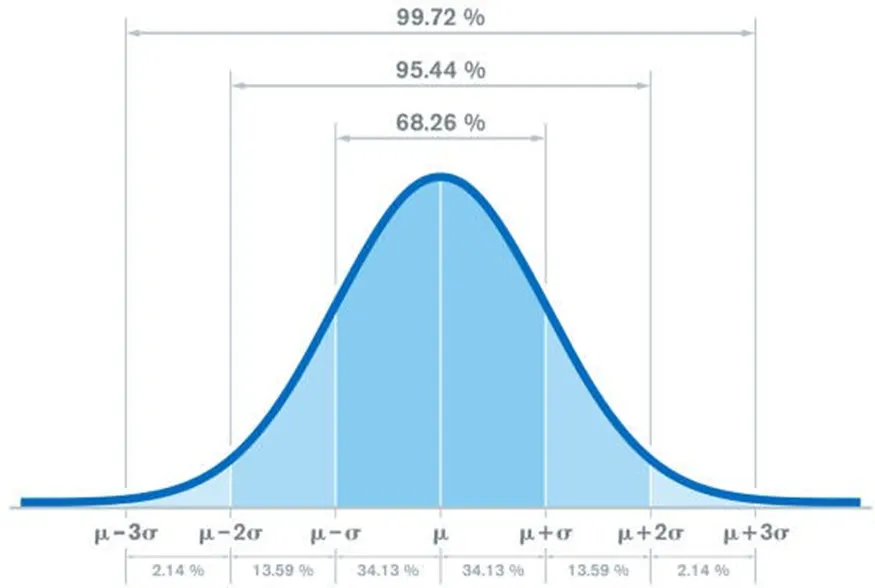
The calculator performs a sequence of calculations. It works out the average of all values entered first. Next, it calculates the difference between each of these and the average. The differences are squared to eliminate negative values. Then the calculator works out the average of those squared differences and roots the final answer. The answer you get is the standard deviation. The calculator automatically calculates each step and shows the answer in seconds.
What can this calculator calculate?
There are many useful statistical measurements available in a standard deviation calculator.
It can calculate:
● Standard deviation.
● Mean or average.
● Variance.
● Total number of values.
● Sum of all values.
● Minimum value.
● Maximum value.
● Data spread.
These results can enable users to gain a better understanding of the consistency and/or variability of their data.
The importance of Standard Deviation
Standard deviation is one of the most important measures in statistics as it measures the spread of data from the mean. Small standard deviation indicates that the data are tightly clustered around the mean. This means that the results are reproducible. A large standard deviation indicates that the data points are more widely distributed. This means that there is more spread in the data values. Knowing this variation allows researchers, businesses, teachers, and scientists to make informed decisions. There are several benefits to using a standard deviation calculator.
The use of a standard deviation calculator has a few advantages.
There are numerous benefits of a standard deviation calculator.
It can carry out complicated statistical functions in a matter of seconds. This saves time and reduces mathematical errors. Every calculation is done using accepted statistical methods, which also helps to make the calculator more accurate. Users don't have to recall formulas or make long-hand calculations. Another advantage is the convenience. The calculator can be used from nearly anywhere, on computers, tablets, and smartphones.
It is simple and easy to understand, making it easier for people without a great deal of experience with data analysis to do so better, and providing professionals with reliable statistical outcomes.
Calculator suitable for?
A standard deviation calculator is helpful for a variety of people. Students employ it in their learning of statistics and mathematics. It is used by teachers in lessons and work. The standard deviation is used to analyze experimental results. Laboratory data is analysed by scientists to determine consistency. Business analysts review business performance. Investment risk is measured by financial professionals. Patient data is analysed by healthcare researchers. It's a calculator that anyone dealing with numerical data can use.
To get accurate results, follow these Tips.
Accurate results start with accurate data. It is important that all values be entered by the user, and that no numbers be missed or duplicated. Any typographical errors can have a large impact on the outcome of the standard deviation. It is also important to be aware of whether a population standard deviation or a sample standard deviation is being used. Many calculators give the option to select between these two. Users should always check the data entered to make sure it is accurate before calculating.
Clean and accurate data always generates reliable stats. Standard Deviation is used in many applications in the real world.
Standard Deviation has several real-life applications.
In many industries, standard deviation is used due to the fact that knowledge of the variation is important in making decisions. It is used in schools to analyse the results of examinations. The quality of products and sales performance are measured by businesses. In scientific experiments, researchers determine consistency. Financial analysts analyse investment risk by analysing fluctuations in price. Manufacturers pay attention to the quality of production. Medical experts review medical studies and patient results.
The standard deviation is one of the most commonly used statistical calculations because it is used to measure variation in nearly all kinds of data.
Frequently Asked Questions
What is the meaning of standard deviation?
It indicates the degree of variation or dispersion of the data values from the mean value. A smaller number indicates that the data are more uniform.
Why is it that the standard deviation important?
It can be used to measure data variability and is used extensively in statistics, finance, science, education, and research.
What is the difference between variance and standard deviation?
Variance equals the average squared difference from the mean, and the standard deviation is the square root of the variance and is easier to interpret.

Conclusion
A Standard Deviation Calculator is an essential statistical tool that measures how much data varies from its average. It automatically calculates the standard deviation, variance, mean, and other helpful statistics, making complex calculations easy and quick within seconds. This calculator will give you speed and accuracy in learning statistics, studying data, analyzing performance, and measuring risk in business or in financial analysis. A standard deviation calculator can be used to show users the variability in their data, which can lead to more accurate analysis, better decision-making, and more reliable conclusions.